



Thinking Sideways by Jennifer Shahade, 2026, Pegasus Books 272pp
First of all, two disclosures. I was sent a copy of the book by the author (I have since purchased other copies for friends), and I have known Jen for several years. I strive mightily to show no bias in any reviews I do, but I’m aiming for full transparency here.
Back in 2023, when she released Play Like a Champion, her book, a natural, expanded follow-up to her prior book Play Like a Girl, in the same way that Chess Queens was the natural successor to Chess Bitch, Jennifer did some pretty typical promotional interviews. I believe it was on an episode of Ben Johnson’s podcast, Perpetual Chess, where I first heard her mention that she was getting ready to embark on a far more ambitious type of book.
The way she hinted at the topics that this mysterious project would entail was alluring in the same way that when you look at photos of the first Hollywood Stars, you can see something there, even if you can’t quite tell what.
Over the next couple of years, whenever I heard a reference to this project, I would be intrigued all over again. Especially as I began to piece together that this book wouldn’t be about improving at games such as chess or poker in the traditional sense. Instead, the book would be about how to approach the thinking part of the improvement process from a whole new direction.
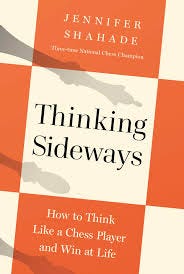
Here is the copy of the North American Edition. The cover in my banner above is from the UK Edition, which is the version I own.
Let’s open the pages.
The book is composed of seven chapters and a conclusion. The chapters are:
Decision Trees
Time Management
Memory
Pattern Recognition
Ambition
Know Your Strengths
Taking Risks
Reading this book will take you on a journey of thinking. Not just thinking in straight lines, but thinking sideways. The idea is that if you want to solve a problem, you should approach it from every possible angle. When the direct approach stalls or fails, there may be a side alley you can try.
Rather than comparing the various chapters to one another to draw parallels and conclusions, I prefer to give the reader an overview of what has really stuck with me. Unlike many books, I didn’t read this one over the course of a couple of days. Instead, I sat down and read the first half quickly, then life got in the way.
Once I got things back on track, I started slowly reading through and absorbing some lessons from the books while taking some notes that now form the basis of this review. So, rather than trying to quickly assimilate and then regurgitate what I have learned, as is the historical tradition of most book reviews I have done, I was able to really mull over many of the concepts and lessons.
Tunneling
One concept that really resonated with me was the idea of “tunneling” as it relates to candles. If you are into candles like I am, then you are familiar with this concept, even if you didn’t know the name.

Tunneling is when you light a candle, let it burn for only a short time, then extinguish it. Since you didn’t let it burn for long, the wax didn’t melt evenly across the surface. Without addressing this, you will not use all the wax in the candle before the wick is gone.
When it comes to learning or training, it’s easy to see the equivalents of tunneling. Let’s say you are working to improve at chess. You know you need to analyze your games. So you start to analyze one. You start playing through the opening, and then you get distracted when you realize you were meaning to look up this opening after the game, but hadn’t done so yet.
So you open Chessbase, and you start clicking through the moves of the opening. Then you realize that a Chessbase database can give you the moves, but not the ideas behind them. So you go to grab that book on the Petroff from your bookshelf.
You start working through the first line, but then you realize the book is from 2013, so you log in to Chessable and buy that new course. At this point, you’ve lit several candles, but you haven’t allowed any of them to burn evenly before moving on to lighting the next. Therefore, what have you really learned? You started out determined to improve by analyzing one of your games, and an hour later, you’re in the quick starter of some Lifetime Repertoire. At no point did you actually start working on the analysis.
I can tell you from personal experience that merely being aware of the concept of tunneling has led me to be far more aware of the need to give training sessions enough time to
Sleep
This one also resonates with me very deeply on a personal level. In the past 2-3 years, I have lost close to 90 pounds. A question I am frequently asked is some variant of “what is your secret?”
What people seem to want to hear is some complicated explanation involving multiple types of highly marketed diet plans (Oh, are you on Atkins/Zone/South Beach/Paleo/etc?) was a very common inquiry.)
Nope. The answer devolves to one thing. Sleep.
While it’s a bit more complex under the surface, on the surface, it’s really that simple. I have lost a lot of weight over the past few years simply by sleeping more. More sleep has reduced the temptation to reach for high-energy foods and drinks that are just sugar and caffeine, leading to less consumption of those things. That has led to more natural energy, which in and of itself reduces the feeling that you need those things to get through the day.
Perhaps, unlike me, you do not need to lose weight for health reasons. Perhaps a goal you are focused on is career advancement. In a case such as this, you might find that more sleep leads to increased ability to stay attentive during meetings. As you pay closer attention, you will have more opportunities to respond to requests for input or suggestions. This may lead your boss to notice you more and develop a higher opinion of your value.
Whatever your goals are, more sleep is far more likely to help than hinder.
Memory
I am someone who grew up with an incredible working memory. I am also someone who was then very actively engaged in behaviors that really hampered my formerly incredible memory.
In Thinking Sideways, one of the subjects Jen interviews is Yanjaa Wintersoul, a former World Memory Champion. Yanjaa explains memory techniques involving crafting stories around the things you want to remember.
An anecdote Jennifer gives in the book is about trying to remember Sarah and Michael, Ellie's parents. So you may use the word “smelly” to remind you that Sarah and Michael are Ellie’s parents.
LLMs
Here is one area in which I wish my notes were better. At one point in the book, Jen dives into some common ways of thinking about LLMs. The term LLM typically refers to a Large Language Model, such as Claude or ChatGPT, trained on massive text datasets to understand, summarize, translate, and generate human-like language.
I have seen a lot of handwringing around LLMs recently, and I’ve done my fair share of it as well. Then, I read Thinking Sideways and gained some insight, which has led to some new hope.
We’ve aleady experienced the invasion of AI into the chess world in the form of engines. One of the fears when engines were introduced and became strong was that they would kill the game. Instead, what changed was the approach to openings and preparation. It broadened the game rather than destroying it.
So perhaps there’s a lot of Chicken Little going around here as well. Listen to Jennifer, we very well may be overreacting here.
Round Number Bias
This is a big one in the chess world since we all have a number associated with our name that frequently changes. Sometimes, though, chasing that round number can do more harm than good.
I know someone in Wisconsin who almost made Master. Within a point or two. I didn’t know him when he achieved that rating, so I may be missing some details, but the bigger point remains.
He decided that when he got close to 2200, he would control the events he would play to get him to the promised land. Many of us have seen this in some form or another over the years. Enter a tournament, crush someone outrated by hundreds of points in round one, then drop out and gain one point, and try to do it again two more times.
Well, something happened, and he didn’t make it. Eventually, he quit playing classical rated events altogether, and the lack of rapid and blitz events in general led him to ride off into the sunset.
I know another guy who made 2199. I haven’t asked if he ever tried to control for the events he played to get that final elusive point, but I do know that he’s still an active player today, so clearly, he didn’t let a round number bias hold him back too long, if at all.
How can you apply this in your life? Let’s say you are trying to get your weight under a certain mark. I’ll use 300 pounds since that was a number I had to fight to get below. You work and work. You’re losing weight and making progress. You are determined to be under this weight before you leave for vacation on a specific date. The day comes, and you step on the scale… 300.1.
OK, you didn’t make the goal, but you barely missed it. The margin is so small that, from a practical sense, there is no difference.
You now have two choices, each leading to its own path forward. Choice one. Embrace the fact that you have essentially made it, and know that if you keep working as hard as you have been, the next time you step on that scale, you are likely to have reached your goal weight, even if not in your preferred timeframe.
Choice two is to feel like a failure and accept the increased risk of backsliding into the same behaviors you are trying to avoid.
One choice feeds the success that brought you this far, while the other may feed the demons that had you on the wrong path in the first place.
Think sideways. Don’t let that bias get you.
Cheating
Wow, did this one resonate with me. Most people reading this probably experienced some form of cheating during the pandemic. Few probably experienced it the way I did.
My company, the International Academy of Chess (I didn’t select the name; I inherited it, so don’t hate me!), was running rated scholastic events online during the pandemic. While the overall number of cheaters was low, they had a disproportionate impact on the final standings, since they usually finished in the top trophies if they cheated enough.
I just checked, and we ran 91 online events, so, sadly, we became very well aware of the cheating epidemic.
Each week, after fair play was complete, we would invite players suspected of cheating to an interview. The guy who was conducting the interview (born in the USSR - you can’t make this up) was really good at them, and the kids would almost always wind up confessing.
Upon confession, we would walk them through how we would allow them to rehabilitate and play in future events. With only one or two exceptions (I can’t recall if it was precisely one, there may have been a second), every one of these kids who were given a second chance played honestly going forward.
This is an important backstory because Jennifer mentions that while kids are much more likely to cheat in any given endeavor, they are also more likely to give up cheating sooner.
To me, the real lesson here is to ask oneself who the real villain is. The eight-year-old kid who once broke down sobbing in one of our interviews, saying he just wanted to make his mom proud by winning a trophy, or the 48-year-old adult who thinks that kid should be banned for life.
If you think cheating is just a simple black-and-white issue, I’d like to point out that I learned to think sideways about topics such as cheating, and you can too.
What’s Your Chess Boxing?
For those who aren’t familiar with chess boxing, it’s exactly what you think it is. It starts with a round of chess, which I believe lasts four minutes. When the chess round ends, the board, pieces, and clock are carried out of the ring, and a one-minute round of boxing begins.
What a concept. Jen talks about the genesis of chess boxing and encourages readers to find their own chess boxing. In this case, a metaphor of taking two things that you might not be the best at individually, but when combined, perhaps you are among the world's elite.
Jennifer talks about her invention combining chess with hula hooping, her dad being both a state chess champ and an Ironman triathlete, and her brother Greg adding being great at trivia to his being great at chess. That last one should resonate with many readers, since Greg just became a three-time Jeopardy champ and is an International Master at chess.
I started thinking about my own areas of interest. I am definitely not the most knowledgeable person in the world when it comes to chess, music, 8000-meter peaks, or the wolves of Yellowstone, individually, but combine two of those, and maybe I’m amongst the elite. (Fine, not if you combine chess and music, lol)
Near the end of the book, Jen tells some deeply personal anecdotes about when she and her husband were starting a family, and how their hopes of having multiple children were dashed after a miscarriage. She then talks about how she even learned to apply sideways thinking in situations such as this.
This actually made me reflect back to when my mom became pregnant, not too long after marrying my stepdad. She then miscarried, but eventually, a couple of years later, my brother was born. I wish she were around so I could try to find out if she was able to apply sideways thinking.
I gave a lot of thought to whether to include this last bit in the review. After all, I doubt many people sit down to read a book about learning new ways to apply critical thinking in an effort to improve, and are expecting to read about menstrual cycles and miscarriages. However, there is a larger point to be made here.
Learning to apply new techniques in a never-ending quest for success, such as thinking sideways, is applicable to all aspects of life.
So who is this book for? Well, in my professional life, I manage a team in a commission-based field, so the ability to improve thinking processes can have a strong, direct correlation with the bottom line for those who work on it. I have already bought copies as gifts for other managers at the firm.
I’d say it’s for everyone. Including you.
Til next time,
Chris Wainscott
Thanks so much for your close and very generous reading!! Right now I am quite worried about AI, job loss and wealth inequality, but I do think that as in chess, some results will be unexpected. Thinking too far ahead is more difficult than ever, hence my book title!